NEXT STORY

Departmental interaction holds the key
RELATED STORIES


Video URL


NEXT STORY
Departmental interaction holds the key
RELATED STORIES


|
Views | Duration | |
|---|---|---|---|
| 81. Electromagnetism, PCAC and global symmetry | 911 | 03:23 | |
| 82. The Stanford meeting of The American Physical Society | 908 | 01:55 | |
| 83. Muon and electron neutrinos | 944 | 01:12 | |
| 84. Collaborating with Feynman | 2975 | 02:40 | |
| 85. Global symmetry. Yang-Mill's theory. Phil Anderson | 1356 | 03:21 | |
| 86. Symmetry schemes | 830 | 03:16 | |
| 87. The Sakata model. A field theory model | 1185 | 02:28 | |
| 88. London and Paris. Partially conserved axial vector current | 786 | 02:31 | |
| 89. The Sigma model | 840 | 00:59 | |
| 90. Sheldon Glashow. The SU(2) times U1 theory | 1251 | 04:10 |


Shelly Glashow was there in Paris and I had a lot of conversations with him. He… he was a student of Schwinger's, and partly under Schwinger's influence, he suggested models of the weak interaction in which the Yang-Mills theory was applied somehow to the intermediate boson–the positive and negative intermediate bosons, the photon and one other particle, which would be a neutral intermediate boson. How that was to be reconciled with the strangeness changing rules was not so clear, but it was a very interesting idea otherwise. And I formulated it I think a little better than he did, although it was his idea. And when I returned from Europe and Africa in the fall of '60, I gave a report on his idea to the Rochester Conference–which was I believe in Rochester. And... and I described it as Yang-Mills theory based on the usual group SU(2) or whatever it’s called, and a singlet which we would call U1; so it was an SU(2) times U1 theory. And I just described exactly how it would… how it would work. But Shelly... But Shelly had included some wrong stuff. He had said that this type of theory was renormalizable, with brute force mass, and of course that wasn't true, as Salam and Kumar had shown.
[Q] But he'd already done SU(2) cross U1 by then, by that Rochester meeting?
Oh, before that, even. Yes, yes. He had written a dissertation perhaps, and anyway a long paper including it and including the mass… the symmetry break and claiming it was renormalizable, which it wasn't. But otherwise it was clever and it was essentially correct.
[Q] Because Schwinger had done SU(2), right? Prior… prior to that. Because he was looking for real unification as distinct from...
Yeah, but that didn't work, of course. No, it didn't work, no, absolutely. That didn't work. Also he tried to deform it into a scalar and tensor theory somehow, because at that time some people, most people thought the weak interaction was scalar and tensor. That didn't work either. But anyway, Shelly and I talked a lot. And we talked also about a Yang-Mills theory for the strong interaction and what the charges could be, and whether these charges would then be the same as the ones that would give super multiplets for classifying the hadrons beyond isotopic spin, and if so, what would that system be. Well, I worked out what it would have to be: to generalize–the idea was to generalize Yang and Mills'... Yang's and Mills' work. What algebraic system could replace isotopic spin? Well, I wrote down the rules for Yang-Mills theory and... that would permit a Yang... a generalized Yang-Mills theory, and I found what the rules were. I had charges that I called F, and the commutator of Fi with Fj had to be–you had to be able to write in a suitable representation as little 'i' the square root of -1, times little fijk, times capital FK summed over K, where little fijk had to be… there had to be a… a way of doing it so that little fijk was totally anti-symmetric. And the Fi's were remission. Well, that's certainly true of isotopic spin where little fijk is eijk, the totally anti-symmetric tensor with indices running from one to three. But what was the generalization of this?
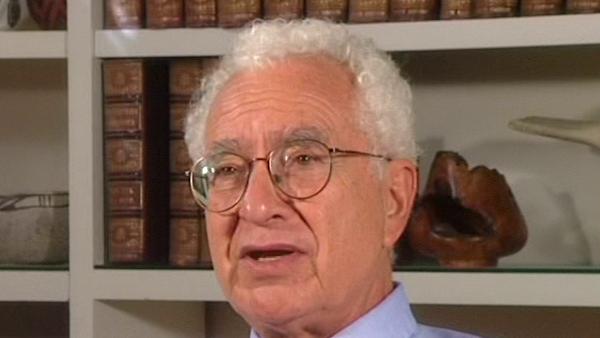
New York-born physicist Murray Gell-Mann (1929-2019) was known for his creation of the eightfold way, an ordering system for subatomic particles, comparable to the periodic table. His discovery of the omega-minus particle filled a gap in the system, brought the theory wide acceptance and led to Gell-Mann's winning the Nobel Prize in Physics in 1969.
Title: Sheldon Glashow. The SU(2) times U1 theory
Listeners: Geoffrey West
Geoffrey West is a Staff Member, Fellow, and Program Manager for High Energy Physics at Los Alamos National Laboratory. He is also a member of The Santa Fe Institute. He is a native of England and was educated at Cambridge University (B.A. 1961). He received his Ph.D. from Stanford University in 1966 followed by post-doctoral appointments at Cornell and Harvard Universities. He returned to Stanford as a faculty member in 1970. He left to build and lead the Theoretical High Energy Physics Group at Los Alamos. He has numerous scientific publications including the editing of three books. His primary interest has been in fundamental questions in Physics, especially those concerning the elementary particles and their interactions. His long-term fascination in general scaling phenomena grew out of his work on scaling in quantum chromodynamics and the unification of all forces of nature. In 1996 this evolved into the highly productive collaboration with James Brown and Brian Enquist on the origin of allometric scaling laws in biology and the development of realistic quantitative models that analyse the influence of size on the structural and functional design of organisms.
Tags: Paris, Rochester Conference, Shelly Glashow, Julian Schwinger, Abdus Salam, Chen Ning Yang, Robert Mills
Duration: 4 minutes, 11 seconds
Date story recorded: October 1997
Date story went live: 24 January 2008