NEXT STORY
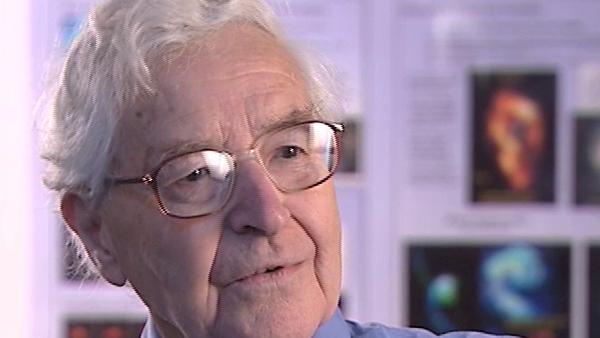

Being treated like royalty
RELATED STORIES


Video URL


NEXT STORY
Being treated like royalty
RELATED STORIES


|
Views | Duration | |
|---|---|---|---|
| 11. Picking up pulsars for the first time | 1 | 220 | 10:02 |
| 12. Who's sending us signals from space? | 145 | 09:34 | |
| 13. Discovering the first millisecond pulsars | 117 | 05:05 | |
| 14. Mapping space weather | 70 | 07:30 | |
| 15. Teaching and notoriety | 103 | 04:23 | |
| 16. Working with computers | 74 | 05:34 | |
| 17. Working on Martin Ryle's telescope | 65 | 07:25 | |
| 18. How radio astronomy has changed | 77 | 07:37 | |
| 19. Winning the Nobel Prize | 189 | 07:09 | |
| 20. Being treated like royalty | 109 | 06:36 |


Well, it’s an absolutely wonderful time when you… when that happens. The news came to me in a rather strange way, actually, because it was a closely kept secret; I mean, they do keep the Nobel thing under wraps. You haven’t a clue that you’re even in the running, at least I didn’t… didn’t think so and I was on a funding committee meeting down in London in the days when it was called the Science Research Council, SRC. And we were meeting in a rather scruffy London building and they didn’t have their own place to meet and the… the clerk came in with a little scrap of paper on which was scribbled the message, in the middle of the meeting, you know. ‘You’ve been awarded the Nobel Prize with Martin Ryle.’ And I just about fell backwards out of the chair because you just can’t… can’t grasp these things at the time. It was hard to concentrate on the rest of the meeting, I know that, but it really was very lucky for me because I was isolated, I was out of contact of the media. And it was my wife at home getting all the telephone calls and so forth and, by the time I got home after the meeting, round about 7.30 in the evening, most of the hubbub had died down, the telephone was still ringing very hard, but the… the pressure had… had gone out of it. And anyway, I was a busy man; it was the middle of the Michaelmas term, I had a lecture to give on the following morning and if you’d been to meetings all day you have to lecture prepare, so I got on with that. I was actually lecturing electrodynamics in the third year’ course, electrodynamics and relativity, and I had the lecture ready. And the following morning I got a round of applause when I went into the lecture theatre at 9am and that was rather nice, the students had heard all about it. But… but life goes on in the university. I mean, you have all your teaching commitments and I… I had a lot to do. And it wasn’t really until the term ended that it really… the message really got through what I… what I had to do.
The whole business of going to Stockholm to get the prize is… is a major event in your life, it’s… it’s even more of an event nowadays because you’re allowed to invite more people, but… but in my case the Nobel Committee said, bring your immediate friends and… not your immediate friends, bring your immediate family. So I was able to go with… with my wife and son and daughter who were then just becoming teenagers at school, which was rather nice, and so we got to Stockholm in the late afternoon, having flown most of the day. And they greet you like total royalty. How they do it year after year in… in Stockholm, I… I really don’t know, but they provide somebody to… usually a young… a young Foreign Office person who greets you at the airport and… and guides you to the reception room where… where the cameras, the batteries of cameras, are waiting for you. And then they whisk you off… whisk you off to the hotel, which is… which is a wonderful hotel on the… beside of the water in… in Stockholm. But the… the nice thing about… about the Nobel Prize is you meet informally a whole lot of people you’ve… you’ve read about and have the chance just to chat to them over the… over the breakfast table. And I got the opportunity, for example, later – not… I’m digressing a little bit from Stockholm – but I got to know Paul Dirac, the famous quantum physicist, who wasn’t the easiest person to talk to, normally speaking, a rather retiring man, but there’s a meeting of laureates every… every year in.. in Lindau on the side of Lake Constance, where laureates in different subjects meet annually to talk to the students of Europe. You would… would normally have about 500 students meeting also and you give… you give lectures in your subject and so on. But I was having breakfast with… with Dirac, and he was presented with the… the glass of iced water, and he doesn’t like water… ice in his drink, and we were having breakfast in the hotel and there was a terrace of people beneath us, we were on the first floor. And he didn’t like the ice in his drink and he was just throwing it out of the window and there were a lot of other people breakfasting down below. There was no uproar then about that, but that’s what I remember about Paul Dirac which I shall always… always recall with some… with some delight.
But, coming back to Stockholm… I mean, it is an amazing… an amazing occasion. The sad thing for me was that Martin Ryle was then… had failing health in 1974 when the award was made and he couldn’t come with me to collect his prize. And… and so I had to collect his prize for him, but the ceremony itself, which is, of course, a white tie occasion, you have to hire all these things before you go, but the… you meet in the… in a theatrical… well, you do meet, actually, in a theatre. You’re on stage with the… all the Science Academicians who have done the work in electing and so on, sitting on the stage beside you, and the Royal Family sitting over there and… and the laureates sitting… sitting opposite. And physics, for some reason, is… is the first. I mean, physics takes pride of place in all the five Nobel Prizes, so… so I had to go up first. And they sort of have a… have a standard fanfare of music and you walk to centre stage where there’s a big circle in the carpet with an N on it, and… in all your regalia and white tie and everything, you walk into this and they play the fanfare and you nod to the… to the audience. And then the King comes up and presents you with the prize and of course I had to stagger away with two prizes. And then they play some national music which they think is appropriate for the times, it’s a musical occasion as well. And guess what I had as a piece of music to go with me? Greensleeves. Which I… I thought really wasn’t a terribly good choice, I would have liked something a bit more lively than Greensleeves. But at any rate, that’s what we had.
Antony Hewish (1924-2021) was a pioneer of radio astronomy known for his study of intergalactic weather patterns and his development of giant telescopes. He was awarded the Nobel Prize for Physics in 1974, together with fellow radio-astronomer Sir Martin Ryle, for his decisive role in the groundbreaking discovery of pulsars. He also received the Eddington Medal of the Royal Astronomical Society in 1969.
Title: Winning the Nobel Prize
Listeners: Dave Green
Dave Green is a radio astronomer at the Cavendish Laboratory in Cambridge. As an undergraduate at Cambridge his first university physics lecture course was given by Professor Hewish. Subsequently he completed his PhD at the Cavendish Laboratory when Professor Hewish was head of the radio astronomy group, and after postdoctoral research in Canada he returned to the Cavendish, where he is now a Senior Lecturer. He is a Teaching Fellow at Churchill College. His research interests include supernova remnants and the extended remains of supernova explosions.
Duration: 7 minutes, 9 seconds
Date story recorded: August 2008
Date story went live: 25 June 2009